| |


I chose Lambert Tower because lets face it how
many of you have gone to an actual castle or been to an actual tower made
of stone on the top of a mountain? Lambert Tower is about the closest
thing you could ever get to European architecture it had to be built by
hand stone by stone. When I heard and read stories about how its haunted,
balls of light are seen surrounding it and how the ghost of Catholina
Lambert haunted it I was intrigued. Think of this place as a freebee I am
giving away to my members since really I visited this site to enjoy the
history rather then the haunts.
Catholina Lambert was born in the village of
Goose Eye, England in 1834. He was the son of working class parents and
came to America at the age of 17 to become wealthy. He started his own
silk mill in 1890 in Paterson, NJ the silk city of the new world. The
castle was built in 1892 called Belle Vista which was on Garret Mountain
overlooking Paterson.
Today the castle is a museum I asked Adam to
show me it and he told me he knew nothing about it. I was pretty upset
about this cause once again someone I left in charge of these places had
very little clue to the area but he claimed to have visited here many
times which the castle is almost more important then the tower historical
wise. Adam told me their was no castle here I knew their was proof of it
is in the article below. So we did not get to visit the castle which is
probably at the base of Mt. Garrett Reserve which is about 538 acres. The
link is here www.lambertcastle.org/
basically you can park here then hike to the tower over a mile away or you
can drive up the mountain and park in front of it.
The castle was more then a residence it served
as an elegant setting for his fine collection of American and European
paintings and sculptures. By 1914 Lambert went into debt and he had to
mortgage his estate and sell alot of his art collection. Lambert did live
in the castle till about 1923 till his death. Upon his death his son
Walter sold the castle to the town of Paterson.
During many years it was used as an air camp
for disadvantaged children and in 1934 Passaic County Park Commission
purchased it and used it as a headquarters for the historical society and
parks department.
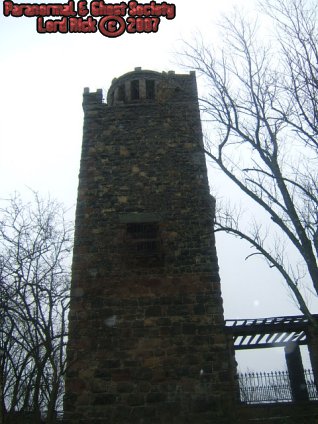
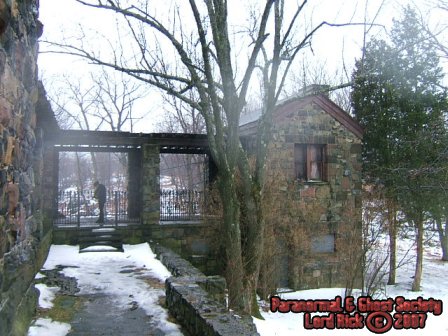
The tower was built as an observation deck
people say it faces the NYC skyline and has a wonderful view. I could not
see much while visiting here it was foggy rain was coming down but we did
get to at least see some deer, I drove around Garrett mountain and I got
some photos of the tower. The tower was open till about the 1960s but
eventually was locked up cause the stairwell was deemed unsafe.
Their
is an old urban legend that was said when Lambert ran into financial
problems he had marble statues and many valuables. He did not want the
bank to take them all so he buried them up on Garrett Mountain. He passed
away before he could tell anybody where they are rumor has it those works
of art are still hidden on the mountain.
Their
is also a huge ancient tree near the tower called Hollow Tree where people
have weddings, propose, and children play in. The whole area perhaps is
more then perfect. Below I have posted a much deeper history in Lambert's
life, the castle and the tower definitely an interesting read.
©
By
Lord
Rick-AngelOfThyNight




The
Story of Catholina Lambert's Castle
Catholina
Lambert was born on March 28, 1834 in the village of Goose Eye, in
Yorkshire, England. He was the oldest son of cotton mill laborers. In the
1830s and 1840s, his parents worked in the cotton mills and had to travel
around the country to find work. Life was not easy, working in the mills
was hard and long, and with little pay. They did manage to send Catholina
to school where he studied until the age of 10. This was much more
schooling than most working class children in England received at that
time.
However, at the age of ten, he had to begin working in the mills.
Traveling far from home, he was able to find work in the relatively
‘benevolent’ Boars Head Cotton Mill. There the owner saw his potential
and trained him for millwork. He finished a seven-year apprenticeship at
the age of seventeen in 1851.
He heard that in England, 1 in 10 working class laborers could hope to
become successful, but in America, 7 of 10 could. And so, at the age of
17, he took his 12-year-old brother William, and left Liverpool, England
on a boat to New York City, USA with their savings of 5 pounds.
1851 Building of an empire
They
arrived in America in 1851. He immediately went to Boston and secured a
bookkeeping job for $4 a week in a silk mill. Silk making was a growing
new industry in America. After 4 years of hard work, the owner of the mill
offered Lambert a partnership in the firm. Catholina ran the company’s
New York office. 3 years after that, he bought out the partner and became
head of the firm, ‘Dexter, Lambert and Company’.
While in Boston, he met Isabella Shattuck, the daughter of a rich
gentleman farmer whose family had been in America for generations. They
married on Sept. 9, 1857. In that year, Catholina also became an American
citizen.
In 6 short years, and at the age of 23, he managed to move from England to
America, become an American citizen, run a successful company in an
exciting industry, and marry into a socially elite family.
In 1858, the couple moved to East 28th Street in New York City, while his
younger brother William ran the Boston silk plant. Not far from New York,
in the small town of Paterson, NJ, the silk industry was flourishing.
Colleagues from Boston set up silk mills there and Catholina soon
followed. His company took over a silk mill on Straight and Clay Streets
in Paterson and produced silk ribbon from raw silk imported from Italy.
While he and Isabella were visiting Paterson, she bought him a piece of
land along the cliffs of Aquackanonk, from what is now Garret Mountain,
east to Broad St. in Clifton. This would be the future site of his
mansion.
He and Isabella had 5 children (Florence in 1859, Frederick in 1861,
Walter in 1863, Isabel Louise in 1866, and Clifford in 1869). The family
spent their time in either of their houses in Brooklyn, NY, and in South
Paterson, NJ. In 1886, they added another residence on Madison Ave. in New
York City.
His family life was full of tragedy however. In 1869, his younger brother
William (30), with whom he had come to America with, died mysteriously
while traveling in South America. In 1870, their infant son Clifford died
of cholera. In 1871, their son Percy was born, only to die in 1882 of
scarlet fever. Another son born in 1873 died within weeks of his birth. In
1875 his first son Frederick died of scarlet fever at the age of 13. A
son, Harry was born in 1875, only to die in 1885 before the age of 10.
Their oldest daughter Florence, married and had a child in 1882 and
another child in 1883. She died of pneumonia soon after, at the age of 24.
Florence’s death was to forever sadden Lambert. In fact, one of the
stained glass windows in the Castle is a portrait of Florence.
His business prospered however. In 1878, he bought mills in Paterson and
designed and built a mill in Paterson in 1879. In 1880, he built a mill in
Hawley Pennsylvania and in 1887 another one in Honesdale, Pennsylvania
which he called the ‘Florence Mill’ after his late daughter.
Lambert’s now oldest son Walter, 22 and his son-in-law William Suydam
ran the mill. The Pennsylvania mills were cheaper to operate as they used
mostly female and child labor. The entire silk industry began moving plant
to Pennsylvania.
Although the silk tycoons were not known for being the most philanthropic
of citizens, Lambert’s wages in the Paterson mills were considered fair.
In 1883, striking workers of another mill used Lambert’s wages as a
standard to meet in their factory negotiations.
1892 The Castle
As
a boy in England, Lambert often passed the castles of Yorkshire and
Warwickshire on his to work in the cotton mills. These were the homes of
royalty, which overlooked the masses of working people living below. He
thought that it was time to have his castle.
In 1891, he began designing a grand new home to be built on the Paterson
property his wife Isabella had bought for him years before. It was located
on a hillside below the cliffs of what is now Garret Mountain and was
constructed of sandstone and granite. The sandstone was quarried from the
surrounding hills. It is estimated that the castle cost one half million
dollars. This at a time when the average wage was $1 a day for 10 hours or
more of hard labor.
In 1892, after only one year, the home was finished. The Lamberts
christened it with a house warming party for 400 of New York City’s
elite on January 31, 1893. President McKinley and vice president Garret
Hobart visited the castle in 1898, Hobart was a Paterson native and his
son was later to be involved in the Castle’s history.
In 1896, the 70-foot observation tower was constructed on the crest of the
cliff. A long gallery building was also added to the main house and was
filled with his huge collection of European artwork.
Lambert kept a small office on the Eastside of the house, overlooking
Paterson and his mills. Since the use of the telephone in Paterson in
1879, Lambert did not have to be in and around the mills as he had before.
He still worked his 16-hour days, but now largely from his Castle office.
In 1900, he started opening the Castle and art collection for public
viewing every Saturday afternoon.
The Fall of Lambert’s Empire
Between
1900 and 1904, Paterson had the Great Fire, 2 floods and a devastating
tornado, all affecting area businesses. In 1901, Catholina’s wife of 44
years, Isabella Lambert died. 3 years later, Catholina married
Isabella’s younger widowed sister Harriet.
In 1913, the famous Paterson silk strikes began. Lambert was 79 years old.
The strikes, together with the absence of capital for loans, due to the
beginning of the WW1, had a severe impact on the silk industry. Lambert
lost a large part of his wealth and was forced to mortgage his estate.
In 1916, he sold a large part of his collection of artwork. He auctioned
off 368 paintings and 32 sculptures. He sold one of his silk factories in
Paterson. By 1917, he and his son Walter began liquidating the assets of
their company, Dextor, Lambert and Company.
Unlike many business bankruptcies of that time, and today, Lambert paid
his debts. He was proud to say that he paid every one of his creditors in
full, largely from his own wealth. Dextor, Lambert and Company had always
been a private company, and no investors ever lost any money either.
Catholina Lambert died in his castle on February 15, 1923 at the age of
89. He is buried next to his wife, Isabella in the Cedar Lawn Cemetery in
Paterson.
The Castle after Catholina Lambert
Lambert’s
son Walter sold the Castle and property to the City of Paterson in 1925
for $125,000. Paterson transferred the title to the castle to the newly
created Passaic County Parks Commission in 1928. Garret Hobart Jr., the
son of the late Vice President from Paterson, became the head of the Parks
Commission. He established the Garret Mountain Reservation as a public
park including the Castle, it’s grounds, and hundreds of acres of wooded
area behind the cliffs above the Castle. The Parks Commission held its
offices in the Castle until the 1960s. The Passaic County Historical
Society and the Lambert Castle Museum were inaugurated on Oct. 25, 1934.
In 1936, in disrepair, the gallery wing was demolished.
Through the years, the Historical Society amassed tens of thousands of
local historical items; many of them housed in the Castle today. In 1976,
the Castle was placed on both the New Jersey and National Registers of
Historic Places.
With generous donations and voluntarism, the Historical Society and the
Passaic County government have managed to keep the museum open from 1926
to the present. Together, they manage the surrounding historical
institutions: the Dey Mansion, the Paterson Museum, the American Labor
Museum, and the Great Falls of Paterson.
The TOWER
The
observation tower on the crest of the cliff, complete with refreshment
stand and stairway leading to the top observation deck, was open to the
public until the late 1960’s. It closed due to disrepair and has not
since reopened. Passaic County has recently received a grant from the
State of New Jersey to fund a tower restoration project. Soon visitors
will be able to go inside and walk up to the observation deck.
The grounds around the tower and along the 150-foot sheer cliffs are open
to visitors of the Garret Mountain Reservation. It offers stunning views
of the area from Bear Mountain NY, to Northern New Jersey, the George
Washington Bridge and the New York City skyline all the way to the
Verrasano Narrows Bridge and beyond to Sandy Hook, NJ.
In August 1995, the Castle property closed down for major repair and
maintenance. After 5 years, it opened again on Sept. 24, 2000 after a
much-needed facelift. The sandstone of the Castle was refinished, granite
replaced and repaired, drive and walkways rebuilt, the walkway to the
observation tower was repaired, and a new northern courtyard was
constructed. The interior was completely refinished.
TODAY
The
Historical Society now holds social gatherings, craft shows, and
fundraisers at the castle. It is a favorite site for newlyweds taking
wedding pictures. The Museum is open to the public throughout the year
from Wednesdays through Sundays from 12 noon to 4 pm. There is a nominal
fee to visit the museum. The Castle grounds are open everyday from dawn to
dusk. The Garret Mountain Reservation Park and the nearby Rifle Camp Park
are open everyday from dawn to dusk
|
|