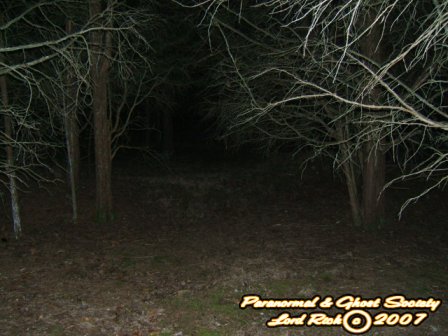
| |




The ghost town of Harrisville
is known for one of the greatest structures of the pine barrens known as
the Harrisville ruins. I spend alot of time reading about this place and
find most who venture out do not find this place they find a totally separate
set of ruins across the way we did just the opposite lol. But without
visiting these ruins the pine barrens just would not be the same in my
opinion its something everybody should see and for various reasons.
Harrisville was a major
papermill town in the Pine Barrens that made paper out of salt hay.
It was near abundant water which is the key element in making paper. This
part of the pine barrens was a major industrial area full of iron furnaces,
glassworks, paper mills etc. Harrisville thrived till about the
1880s. Like most towns during that time they died out in this case
it was due to ownership disputes and changes in processes of making paper
that produced financial problems for the factory closing it down which in
turn caused the residents to leave. A century ago most towns relied
on one or two businesses but when those failed so did the towns in almost
every scenario.
When the town became abandoned Mr.
Harris stayed behind living in the old mill. The forest at that time was
not growing around the mill or town. But over the next twenty years it
would and Mr. Harris went mad. The colonial slitting mill
constructed of bricks brought over as ballast in the hulls of English
ships had now started to fall.
A great fire engulfed the mill
in 1910 it not only burnt the wood supports of the mill but it caused the
roof to cave in. The abandoned ghost town also caught on fire leaving
nothing but foundations. Eventually vandals came in there wagons taking
what remained of this town. No more church bells were to be heard, no more
campers playing on the lake from Atlantic city, and no more town. The
Papermill ruins are just a reminder of the past of what once was. Most of
the buildings fell in ruins and even the biggest building over 300 foot
long and almost two stories high with a 3 foot thick wall no long
existed. What remains is a pile of rubble.
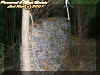
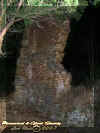
Today snakes basking on ledges,
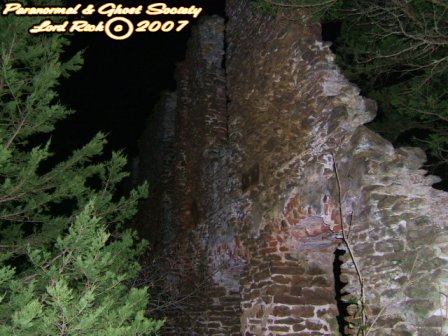
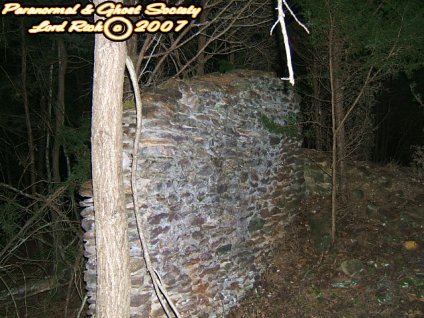
skeletal remains of the paper mill, a section tilted over the creek,
crumbling bricks from the melting mortar are present. If you were to hike
in the woods you would find the canal which we seen, saw mill foundation,
Broome Mansion Foundation, a cellar hole of one of the workers homes,
a well and a few other sites. I did not see anything further back in
the woods the area was very overgrown although to be able to visit the
mill was a nice highlight of our trip.
Before Harrisville was a
papermill town in the 1700s it was known as McCartyville which was known
for its combination saw and grist mill. What makes this place most
interesting is you can clearly see that a town that thrived on its
industry and was molded to be one of the most prosperous ghost towns had
went from a town full of entrepreneurs to desolation. If you wish to
read more in depth about Harrisville I have posted some more history below
author unknown but its very interesting.
As far as paranormal activity
goes I did some studying only to find that their was a Jersey Devil
sighting in the area in broad daylight. It was seen by the ruins watching
then eventually fleeing. I guess you can say that almost every set of
ruins or ghost town in the Pine Barrens has had some sort of Jersey Devil
activity. With over 200 years of history here this town has seen
everything from Horse Wagons to the railroad being born to various wars to
even the Jersey Devil which plagued the Pine Barrens throughout history.
With Mr. Harris staying behind it would be no wonder why he had gone mad
perhaps the Jersey Devil haunted him till his death!
©
By
Lord
Rick

Before Harrisville was called Harrisville, it was McCartyville. Before
that, the place was likely named after many of the entrepreneurs that
started operations there. The first mills started near the site that would
later be known as Harrisville were a combination saw and grist mill
founded by Evi Belangee, Jr. between 1750 and 1760, and the Wading River
Forge and Slitting Mill, founded by Issac Potts in 1795. Potts, who also
founded nearby Martha Furnace two years prior.
Martha Furnace was a large iron blast furnace located short distance up
the Oswego River from Harrisville. At it's peak, the furnace supported
nearly 400 people in the town proper as well as the nearby town of Calico.
Pig iron was the chief product of Martha, although larger items such as
firebacks, stoves, sash weights, etc. were also produced. There was a
demand for finished goods, and as more and more settlements were built in
the Pine Barrens nails became a hot commodity. Recognizing this, and the
fact that there was abundant water power nearby, Potts erected his forge
and slitting mill to process pig iron from Martha as well as nearby
Speedwell furnace.
Potts was more of a real estate speculator than an ironmaster, and in 1797
sold the forge and slitting mill to George and William Ashbridge and
Joseph Walker. A few years later he sold Martha Furnace itself. Hard times
were descending quickly on the iron industry in the Pine Barrens, and the
property changed hands often. Around 1832 William McCarty, Thomas Davies,
and Issac Ashmead became the latest in a long series of owners of the
site.
The writing was on the wall for the iron industry in the Pine Barrens.
Knowing that it would be foolish to continue operating the slitting mill
as furnaces nearby were closing down, McCarty and Davies turned their
attention to paper after McCarty bought out Ashmead's interest in the
property. In 1834 they obtained a mortgage for $10,000 and began work on a
new mill to produce paper.
Work began on a canal to divert water from the old mill pond (now
Harrisville Lake) to a new mill built a short distance from the lake. This
canal, designed and engineered by McCarty, ran for just over three-tenths
of a mile and was dug entirely by hand labor. Fortunately labor at that
time was plentiful, as there were many unemployed iron workers. Workers
were paid 9ΒΆ per hour to dig the nearly fourteen foot deep canal. In
addition to the main canal, a smaller canal was dug to power the grist
mill and a saw mill. This smaller canal was a diversion from the main
canal and reconnected with it before it crosses modern day Rt. 563.
Paper was made from salt hay harvested from nearby meadowlands. Wagons
arrived daily with new loads of hay, as well as loads of scrap paper,
rags, and other old cloth products from New York or Philadelphia. Rags and
old cloth were sorted, cleaned, and buttons, seams, and metal fasteners
removed. This material was then sent through a rope cutter machine that
reduced the material to shreds. This raw material was then wetted down and
dumped down a chute into the prepared stock house. From there the stock
would be brought to two stone vats in the main mill to be boiled and
reduced to a pulp with rotating knives. Later, in the Harris era, these
vats were no longer used and the stock brought to the rotary boiler room,
where chemical action replaced the knives. (Incidentally, the paper
factory at Harrisville was likely the first water polluting industry in
the Pine Barrens. After cooking the pulp in the boilers, the excess waste
water and acids were dumped directly into the mill tailrace.)
The salt hay itself was processed differently. The hay was brought to the
bleaching house, located at the southerly end of the mill. It was cooked
with soda ash in large tubs. Then it was washed several times and brought
to bleaching tanks. The stock was then boiled with lime and chlorine,
which further reduced the hay to pulp. Then the pulp was washed again and
beaten with knives to the required consistency. Until the pulp was used to
make paper, it was held in stuff-chests, which were wooden tanks that were
constantly agitated to keep the pulp from settling. This also helped
further clean contaminates out of the pulp that may have remained from the
bleaching process. From here, the pulp was pumped to the paper making
machines.
The pulp was fed into a machine which agitated and matted paper on a
continuous belt screen. The paper moved through this machine at a rate of
20 feet per minute. A press squeezed the remaining water out of the pulp
before it was pressed under a series of rollers. The paper then traveled
up through the machine to the second floor of the mill where it was fed
into the sizing machine. The sizing machine starched the paper. Finally,
the paper was passed under a polished iron roller known as a glazing
calendar that provided a final finish to the paper and added strength.
The paper produced was 30 inches wide, and was sold in either rolls or cut
sheets. There was a power cutter that would cut the paper to required
lengths. The paper would then be lowered out the Southern end of the
building to barges. Around 1861 the paper was hauled by mule train to
Harris Station, 11 miles away, near Hampton Furnace to make the trip by
train to market.
McCartyville, as it was now known, grew prosperous very quickly. In
addition to the paper mill, which was one of the most advanced in the
country at the time, a grist mill, two sawmills, and a company store were
also built. This store generated a profit of nearly $3,000 annually. To
house his workers, McCarty built several cottages a short distance away
from his mill. He also constructed a dining hall and dormitory, where
workers could have a hot meal each night in exchange for a weekly fee
taken from their pay. Across from this dinging hall, McCarty built himself
a fine mansion. Plans were drawn up for a second paper mill to further
increase output.
Disaster struck in November of 1846. A fire broke out at the paper mill
and heavily damaged the building. In 1847 the Wading River Manufacturing
and Canal Company, as McCarty's enterprise was called, repaired the
building and began processing paper again. However, the financial strain
of rebuilding the mill was too great for the company to survive for long.
The property was sold at a sheriffs sale. McCarty was able to buy back one
quarter interest in the property, but at this point in time it was too
late. The mill was idle, and McCarty sold his interest in the property to
Thomas Albert Haven.
On May 1, 1851 Richard Harris and his brother Benjamin gained control over
the property. There were some legal problems that did not get resolved
until 1855 due to the death of Thomas Albert Haven and his heirs
subsequent wrangling over the property. In 1856 the Harris's obtained a
mortgage for $7,552.86 from John H. Simon who controlled the remaining 3/4
of the McCartyville property. Simon agreed to finance the Harrises
purchase of the property if they offered their own quarter as security.
The Harris brothers agreed, and on November 2, 1856 finally had full
control over the property. By 1858, several other Harris brothers and
their father bought and sold interests in the property. Around 1858, after
the mill had been put back into operation, the sole owners of Harrisville,
as it was now known, were Richard and his father John. John, however, only
wanted to offer financial and management assistance to the company. The
real leader behind Harrisville's day to day activities was Richard. John
Harris retired from the company in 1866 and returned to his native
Philadelphia.
Harrisville went through a period of rapid expansion. In 1858 Harris
obtained a mortgage for $12,000 and paid it back within 5 years. It is
likely then that he built the two mansions opposite the mill, modernized
the mill, created the Harrisville Public School, and added several other
buildings to the property. The former McCarty mansion and opposite dining
hall were split into two-family houses. The main canal was enlarged, and
in 1865 a booster
canal was dug between the West Branch of the Wading River to the
Oswego to increase the level of the lake. In 1866 the artesian well was
dug, and subsequently abandoned due to the high iron content in the water.
Around 1867 the famous Springfield Gas Generator was installed at
Harrisville. This allowed gas powered illumination for some of the homes,
as well as streetlights along Main Street. The generator house, located
under what today is Rt. 563, had a large tank for storing gasoline. Air
was pumped over this tank which vaporized the gasoline and forced it under
pressure to the various light fixtures throughout the village.
By 1877 the town was beginning to feel the effects of age and competition.
More modern mills both outpaced production from the nearly fifty year old
Harrisville mill and had better connections to railroads. A new mortgage
for $20,000 was secured in 1888, but by 1891 the property was in
foreclosure and sold in a sheriff's sale. The property was subsequently
bought and foreclosed on again, being bought by a mysterious stranger on
June 13, 1896 for $30,000. This stranger, when called upon to pay the 10%
down payment for his winning bid, announced that his pocketbook,
containing a certified check for $25,000, was missing. Finally, after
being verbally assaulted by several of the other bidders, the stranger
fled never to be heard from again. A new auction was held, with Mark Sooy,
an agent for Joseph Wharton winning the auction for $12,000. When it was
time for Sooy to pay the 10% deposit on the property, Elias Wright,
another agent for Wharton, collected checks from Sooy and Jerome Grigg. He
presented the sheriff with three checks from Joseph Wharton, totaling
$1,200. The crowd was outraged at the fact that he had employed shill
bidders, and Wharton held his breath if the sale would be invalidated. It
was not, however, and on July 16, 1896 the deed was presented to Wharton.
The village was still in remarkably good shape when Wharton too possession.
Several of the families who had worked at the Harrisville mill still
continued to live at the site, resorting to berry picking to eak out a
living. The two mansions were in fine shape, one of them still containing
furniture owned by Richard Harris. This was later moved to the house in
New Gretna that Richard and his brother Howard were living in. The mill
itself had been damaged by another fire and was nearly useless. Wright
suggested to Wharton that the mill building be torn down and the machinery
sold for scrap. It was estimated that $100 would be realized for that
effort. Wharton, thankfully, never headed that advice. The Broome family,
longtime friends and employees of the Harris's, were allowed to live in
the smaller mansion rent-free if they would act as caretakers of
Harrisville for Wharton. Wharton invested some money into repairing the
dam at the pond as it was Wharton's intention to dam as many of the ponds
and rivers in the Pine Barrens and transport that water to Philadelphia.
After the New Jersey legislature banned the sale of New Jerey water
outside the state, Wharton turned to agriculture and likely leased some
land to a cranberry bog operation nearby.
In 1909, after Wharton's death, the YMCA of Atlantic City finally obtained
permission to use the Harrisville site as a summer camp for boys. Wharton
himself forbid it, but his estate seemed to be more open to the idea.
Several of the buildings were converted into camp offices, kitchens, etc.
In the spring of 1910 a group of boys became the first campers at Camp
Lyon. Finally, in April of 1914 a forest fire swept through the town and
obliterated the remaining structures.
Vandals and treasure hunters swept down on the village. Gone were all of
the iron gas lights. Stone was carted away. Years of erosion and weather
took their toll on the town. The mill walls, which were all still standing
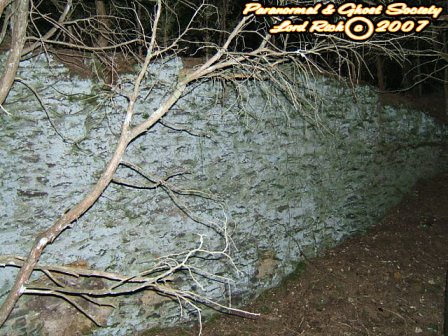
after the fire, crumbled. Today, only the South wall and a small spire
from the North wall stand. Two walls from the grist mill still stand,
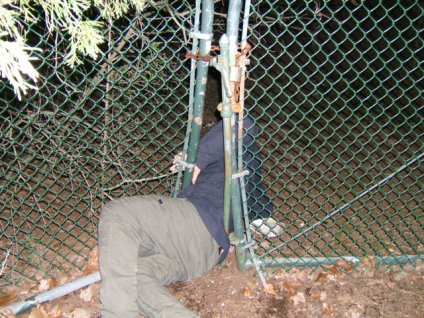
barely. In the 1970s the state erected a chain link fence around much of
the main mill to protect it. Unfortunately the damage has been done and it
is very likely that much of the remaining ruins will be gone in the next
fifty years.
|
|