| |
The name Atsion was derived from the word
Atsayunk which is what the Indians named a local stream that passed
through the town. Today that is called the Mullica River one of the
hottest spots to see the Jersey Devil. Purchase of the land took
place in 1755 when Charles Read and Thomas Gardiner purchased 1100
acres.
In 1765 John Estell a business partner of both
men who purchased the tract built a damn across the Atsayunk which would
be used to power a saw mill. Charles Read then bought the rights and built
the Atsion Iron forge which was used to convert pig iron from Batso into
bar iron. By 1770 there were four forge fires and two hammers. This forge
was used to produce iron in the american revolution. John Estell was the
owner of the Estell Glassworks which you will also see photos from our
visit there on future pages from our Pine Barrens adventure. You will also
read and see Batso so everything as you can clearly see has some sort of
connection.
Charles
Read was financially strapped and had physical ailments so he sold his
interest in Atsion in 1773 to Henry Drinker and Abel James from
Philadelphia. In 1773 Lawrence Saltar acquired the remainder of interest
which was nearly half of the entire interest. Those three new partners
formed the Atsion Company which operated the works for 13 more years. The
company purchased Blast Furnace Machinery to process the bog ore in the
local lake bed and connecting streams nearby instead of relying on importing
pig iron from Batso a eight miles downstream. By 1804 the
partnership ending do to conflicts.
In
1805 the son in law of Henry Drinker named Jacob Downing purchased 20,000
acres which including the Blast Furnace, Air furnace, forge, sawmill and
Gristmill at an auction. He made the iron works prosper for a few
more years then mortgaged his interest in Atsion to the Bank Of North
America and in 1822 the bank sold it along with the Hampton Furnace track
just a few miles away to Samuel Richards the son of William Richards of
Batso. Samuel Richards built the giant mansion in Atsion in 1826 along
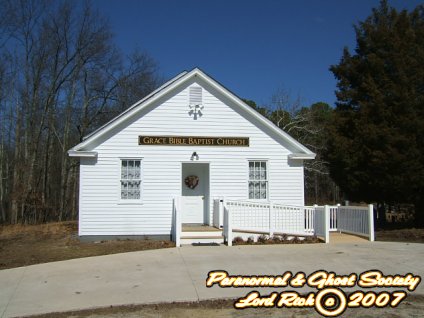
with a couple dozen dwellings. The Quaker/Methodist church and company
store were built in 1827 and 1828. He had a work force of about 120 men at
that time till his death in 1842.
After
his death he left half of the estate to his daughter Maria and the other
half to his son William. In 1849 his daughter Maria married William
Flemming of SC. In 1852 he tried to open up a paper mill since the
local iron industry basically fell apart. The mystery to the town was
whether the mill actually ever opened. In 1854 to seek protection from his
creditors he left the country along with Maria in Brussels. He went
bankrupt and the collectors wanted their money.
In
1861 Jarvis Mason of Philadelphia bought the property. A little
before that time in 1856 William and John Torrey launched the Raritan and
Delaware Bay Railroad. In 1860-1861 those train tracks reached Atsion
which became their temporary southern terminal. A connecting line was run
to Atco, connecting to the Camden and Atlantic Railroad which was later
taken over by the Pennsylvania Railroad. The Torrey's who operated the
trains from NYC to Camden, via Atsion starting in 1862 eventually went
bankrupt by 1967. The railroad was not all a waste though it did flourish
during the Civil War as it helped transport troops and supplies.
In
1871 Maurice Raleigh another wealthy man from Philadelphia bought Atsion
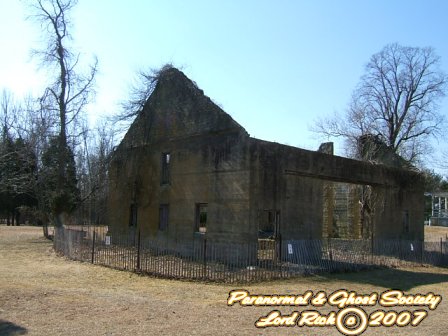
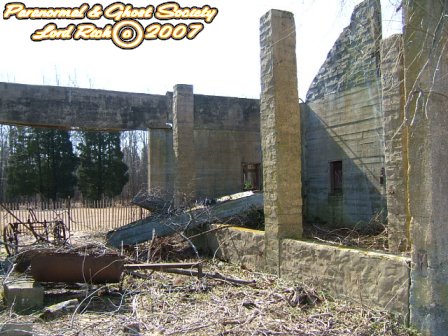
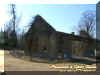
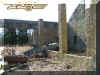
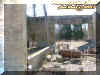
and he built a cotton factory which the ruins still remain today. He
changed the name back from Fruitland to Atsion. The cotton mill is a truly
magnificent little structure. When you hear cotton you usually think
further south. Today some of the old cotton equipment still remains.
In
1892 the property was acquired by Joseph Wharton which is now part of the
Wharton State Forest when NJ purchased the land in 1954. When Wharton
owned the property he had a man by the name of Andrew Etheridge run the
general store and care take the town. In 1925 he died but the family continued
to live in the caretakers home until the state purchased it.
Today
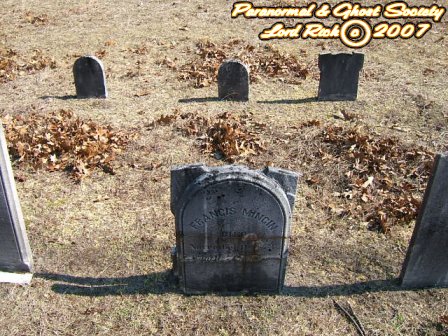
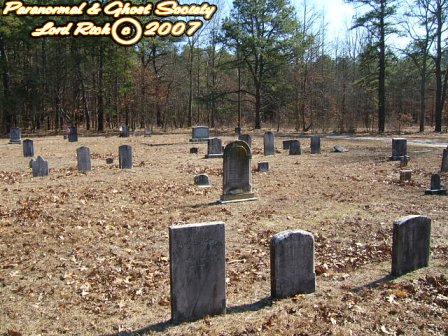
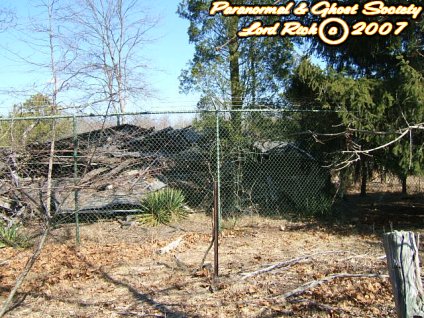
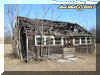
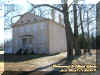
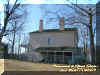
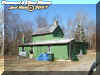
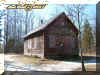
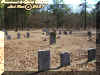
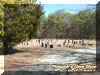
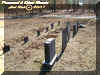
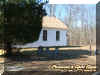
not much remains the church, cemetery, cotton mill ruins, the Greek
Revival Richards Mansion and a few other structures remain. However the
ghost town dates back to the 1700s its one of the older more prosperous
ones that still remain partially in tact. Its also one of the first
ghost towns that borderlines the Wharton State Forest so its not very deep
in the Pine Barrens.
Despite
that fact it was a hotspot for Jersey Devil activity in 1978 when a couple
saw this creature at Atsion Lake which sits across from the ghost town.
They claim they seen it on the shoreline moving through the underbrush
while they were canoeing. Just as a group of campers in Atsion that they
heard screams throughout the night which kept them up. Those same screams
were also heard up in another ghost town we visited named
Smithville. I do think sightings in Atsion are higher simply because
its on the Mullica River which seems to be a hotspot for this creature.
Their are of course many other accounts of sightings and one of the best
ways to get deep into the Pine Barrens is to take the stage coach road
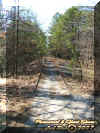
through Atsion and into the woods. Today the train tracks lay overgrown
giving you a reminder of what was once a bustling little community.
©
By
Lord
Rick
Atsion
By
Douglas Entwistle
As
most of you already know Atsion is a small village on the southern boarder
of Burlington County. For the most part the homes and buildings are gone,
but there are a few notable exceptions. The mansion, the country store,
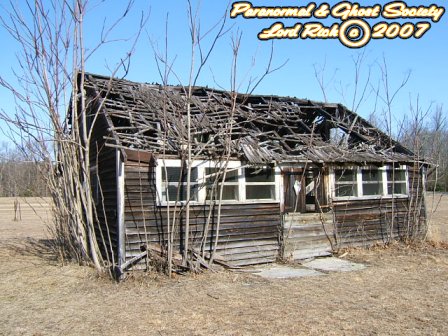
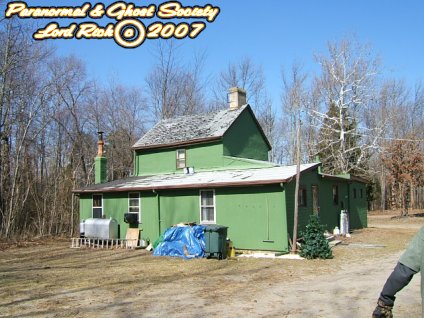
the old Atsion Church, old school house and a tenant house.
Prior to the state purchase of the "Wharton Estate" in the early
1950's Atsion was still an active community. The old tenant house is a
double house and the half that my parents lived in was still occupied. As
with most of my life experiences it's last tenant was a bit out of the
ordinary. He happened to be a Circus Clown. His name was Bill Bailey and
on occasion worked in Philadelphia for a TV station. At one point he
produced a short movie for TV. For the movie he needed a fire engine. Upon
the movies completion, he parked the fire engine next to his house, where
it rested for many years. This became a monument to my children, their dad
was born in the house with the red fire engine parked out front. This
proved to be somewhat prophetic, Almost all of my family became involved
in public service working or volunteering as firemen, emergency medical
technicians, and police officer. It is possible that the fire engine had a
small part, among many others, sparking their interest in sirens, rotating
red beacons, and bright red vehicles.
I guess what ties me to Atsion more than anything else, that still exists
today, is a small concrete sidewalk. This sidewalk started at the gate of
a picket fence that surrounded the home of Anna and Sid Crain. They lived
in the other half of the double house mentioned earlier. Often during the
summer months my mother would walk to Atsion, taking me with her to visit
Anna Crain. I would like to explain, I have no memory of living in Atsion.
We moved about a mile north on Rt. 206 when I was about 6 months old. My
early memories are from those visits. But back to the sidewalk. One of
Anna Crain's boys had a little toy car you sat in and peddled. I would
spend hours riding back and forth on that sidewalk, driving a
"real" car.., in my imagination. In the yard, happened to live a
raging "beast" in the form of a dog. Now this was no ordinary
dog, I remember that it looked like a beagle but the likeness ended there.
This dog was NOT a pet, the dog was absolutely vicious and I am convinced
had no redeeming qualities other than scaring living daylights out of
friend and foe alike!. Mr. Crain had him on a leash attached to a wire run
ending just short of the fence gate. Anyone coming through the gate would
be confronted by a snapping, snarling dog that became airborne as it
lunged toward him, apparently aiming at his victims throat. The leash
would come up short, spinning the dog to the ground where it would
continue to snap and snarl at the intruder. Being an intelligent man, Mr.
Crain fed the dog by pushing it's dish to it with a broom handle! After a
short while the dog would ignore me as I peddled back and forth in my
little car. Although, believe me, I kept my distance from him!
Back in 1989 I renovated a building on my property into offices. During
the construction I had them build a concrete sidewalk between the back
porch of my house and the rear of the office building. The sidewalk is
about 50 feet long and I specifically had it constructed to duplicate the
little sidewalk in Atsion. Everyday I walk on my sidewalk it brings back
memories of those days long past. I must say as I reach the end of my
sidewalk, I am tempted to look to my left, to make sure the
"dog's" chain is secure. What really shocked me was how small
the sidewalk from the past really was, when I visited Atsion last year. I
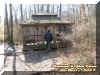
would like to mention "Etheredge's Store". The Park Rangers are
now using it as their Station Office. The building is the first structure
on the left as you enter Atsion going south on Rt. 206. The building
resembles a church. I believe there once existed a bell tower. I could be
wrong. As you entered the front door, the counter was on the right. On the
counter sat a large coffee grinder with two large cast iron wheels. The
machine was dark reddish brown with pin stripes of gold leaf and little
hand painted floral designs. One of the wheels had a handle attached to
turn it. Oh! what a heavenly smell. Next to the coffee grinder was a roll
of brown paper with an iron weight that acted as a cutter. Included was a
roll of binder twine, the twine threaded thru a wire eye for tying
packages. In front of the counter stood barrels of pickles, crackers and
other wares. Above the barrels behind a curved glass showcase was a
selection of penny candies. To the left sat a pot bellied stove, it's
stove pipe snaking nearly to the ceiling before entering the chimney.
Other wares, kerosene lamps, buckets, scrubbing boards etc were on
display. On the wall above the offering hung a hexagonal
"school" clock, it's pendulum slowly swinging, producing a
relaxing, almost hypnotic ticking sound, tic - toc --- tic - toc, how
peaceful and serene it was. It's enough to say, the sights, the sounds and
smells were memorable. Outside just off the highway stood one orange and
blue GULF gasoline pump. It was the type, you pumped by hand. As you
pumped you filled a glass container on top to the gallons marked by a
vertical measuring indicator. This you multiplied by the price per gallon
($.17 @ 10 gallons = $1.70 ), how do you like those prices? Circa: 1939
-.You then dispensed it by gravity through the hose into the car's
gasoline tank. Guess where you could purchase gasoline when the electrical
power failed? Overseeing this empire was Mrs. Mamie Etheredge. A gray
haired little old lady that was a bit hard of hearing. I discovered
quickly you had to speak directly at her in a loud voice for her to hear
you.
Behind the store stands the mansion. Back in the 30's it was in dis-repair
and the standing order to all the children was "stay away from the
mansion". I was told that some of the older boys who braved stories
of ghosts, cobwebs and rotted floors actually went inside. Upon their
returnthey told stories of the unnatural sights and sounds they
encountered, thus persuading the younger children, which included me, to
steer clear of the "mansion". I doubt that anyone ever
"toured" the mansion at night. It has to be noted that Atsion
was the perfect place for stories about the "Jersey Devil", the
"Headless Horseman", ghost, and spirits. You have to picture
large dark silhouettes of the old buildings against a moonlit lake as
their backdrop. The only lights visible were usually kerosene lanterns
flickering and shining through windows of the occupied houses and
lightning bugs flashing in the fields. Do you remember their lights
changing to thousands of little streaks as you watched them from a
speeding car's window? As darkness fell, Atsion filled with night sounds.
In the summer crickets, katydids, frogs and the Whip-or-will could be
heard just after sunset, it's soft voice calling whip-or-will,
whip-or-will, whip-or-will, each call numbering three. Softly layered on
this background of sounds, the occasional hooting of an owl. Speaking of
owls, there is one sound you will never forget., especially in Atsion, it
is the call of a "Screech Owl". If you've never heard one, they
sound like someone screaming in pain! Then there was the constant sound of
black water cascading over the dam, feeding the Mullica River. Walking
along the darkened paths, often you would be startled by a night flying
bird or confronted by someone appearing out of the darkness in front of
you. In the winter on very cold nights when the lake was frozen solid, and
you walked bundled against the cold, you would hear prolonged cracking and
booming sounds on the lakes surface as the ice fractured, giving way to
pressure as it expanded.
The little Atsion Church also added to your quickening step. Just beyond
the front entrance was and is a very old tree with only a few of it's
branches still alive. At the proper angle in the moonlight you could
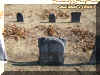
imagine it being one of many threatening beasts. A small grave yard with
30 or 40 headstones, some standing askew in the moonlight ompleted the
scene. All the dangers were perceived, none were real.
Traveling past the church on Quaker Bridge Road, the next building of
significance is located about 50 feet to the right of the road. This is
the Atsion School House. My mother who is 90 went to school there. There
is a family photograph of her standing beside the building with some of
her school friends. The picture suggests that she was about 10 years old.
Continuing on you come upon a railroad crossing, the tracks now overgrown
and abandoned. About 100 yards to the right stood the Atsion Train
Station. The train station was closed very early in the 1930's although
the tracks were still in use to about 1960. The trains arriving and
leaving gave me my first glimpse of steam engine driven trains. I believe
that very early in my childhood, I recognized a lifetime fascination with
steam trains. There is no other train engine that has the character and
personality of a steam engine. In every way they display their uniqueness
through sound, the explosive release of steam as the pistons strain to
pull it's heavy load. The whistle warning those standing near, that the
train is moving. This was an awesome sight, at least to a small child,
this huge machine belching smoke and steam, it's drive wheels screeching
and spinning, as the engineer gently eased forward on the throttle,
adjusting the engine's power, trying to maintain traction between the
drive wheels and the track. Added to all of this the ringing of the bell.
The sight was doubly intensified at night by the orange glow of the coal
fire box ejecting a shower of glowing cinders as the coal stoker shoveled
on more coal. All of this scene silhouetted against a backdrop of moonlit
pines. To compare this with the diesel or electric engines of today lacks
virtually all of the sights and sounds of yesterday. How many of you
still, if you happen to arrive at a railroad crossing as the train is
passing, count the cars being pulled by the engine? I know that I still
do. At least if the train appears to be a long one. A few years ago my
wife and I visited Colorado, while there we drove up into the mountains to
a town called Leadville, the town of "Unsinkable Molly Brown"
fame. It also sported the fact that the town's airport was the highest in
altitude of any airport in the United States, over 10,000 feet. On the way
we saw a freight train being pulled by 4 diesel engines slowly climbing a
grade. The engines were straining under the load probably traveling less
than 20 miles per hour. I immediately found myself counting the cars even
though we weren't waiting at a crossing.
Oh, by the way a penny placed on the railroad track with a 30 or 40 car
freight train passing over it will transform the coin from a round penny
to an oval penny devoid of all stamping. For whatever that's worth! Many
years ago the train station was purchased by the Gardner brothers, farmers
of Indian Mills and moved to it's new location about 100 yards to the west
of Rt. 541, about a mile north of the Rt.#206 intersection. It was used
for several years as housing for farm laborers. The building today has
collapsed leaving only a pile of scrap lumber marking the spot where it
once stood. A sad memorial to a once thriving public transportation link
to Philadelphia and New York.
A product produced at Atsion during the winter season was ice cut from the
frozen lake. This was accomplished by men with large "ice" saws,
about 4 or 5 feet long with a "T" handle at the top. The saw had
very course teeth designed for cutting ice. When the ice was thick enough
they would cut it into blocks and store it for many months in the
"Ice House" located near the site of the new building the state
constructed for swimmers. My mother spoke many times about the "Ice
House". For some reason I got the impression that the building was of
modest size and was surprised when I saw a picture of it in a publication
called "A Journey Through Atsion" by Sarah W.R. Ewing. It was
large, dwarfing a freight car resting next to it awaiting a load of ice
for a trip to the city. It appeared to be about 250 to 300 feet long and
about 4 stories high, made entirely of wood. I understand that ice could
be stored, packed in saw dust insulating it, thus making ice available
through the summer season. How different it is today with our
refrigeration and freezer systems. Just imagine how labor intensive it was
to cut, store and deliver ice to the public for food preservation.
As a teenager and young adult, Atsion Lake played a pivotal roll in my
life. It was the place to go on hot summer days that eventually led into
warm summer evenings. There were two beaches (we called them coves) one
next to the highway, the other located at the end of a dirt road that
passed a tiny grave yard with just two head stones. A short distance
beyond the graves, the second "cove"was located on the spot that
is now occupied by the Visitors Center. My friends and I would usually
swim off the beach located near the highway. There were a couple of tree
stumps hidden under the surface of the cedar colored tea brown water that
if I swam there today, I believe I could still find with my feet. There
was one stump that was in about 8 feet of water, find it and you could
stand with your head well above the surface.
I guess almost everyone, especially when we were teenagers acquire fond
memories. We didn't recognize their importance at the time, but upon
reflection, become precious to us in later years. We keep them tucked away
on dusty shelves in the closets of our mind. Now and then something, an
odor, a certain song or maybe a place will bring it all back, usually,
only for a moment, but quoting the late Jackie Gleason "How Sweet It
Is!" You remember your friends and childhood sweethearts as they
were, and wonder, if they are still living, how they may look today. It is
fitting, I believe that you should never get the chance to see them now.
Because your memories of them as they were, keep those wondrous years
intact. Not that they are not beautiful people in their senior years, but
your memories of them the way they were, give you a firm grip on that
sometimes bittersweet past. The same would apply for them if they saw me
today. Also what may have seemed to you then as the perfect girl or boy
for a mate, probably would have ended in failure. We were too young and
these loves were just part of growing up. Although I do hope that they...,
briefly, in quiet moments, remember me.
These are some of the memories that Atsion offers me when I visit there.
These visits give me mixed emotions, on one hand the "Village"
brings back those experiences, on the other I have a sense of sadness.
This sadness overtakes me when I look at it's abandonment. But towns come
and go based on their ability to stay with the times. It is apparent that
Atsion, like other Pine Barrons towns, eventually will only be a footnote
in local history.
|
|